
Best IPTV Encoder 2026: Top Models Under $500, $700 & $1000 Compared
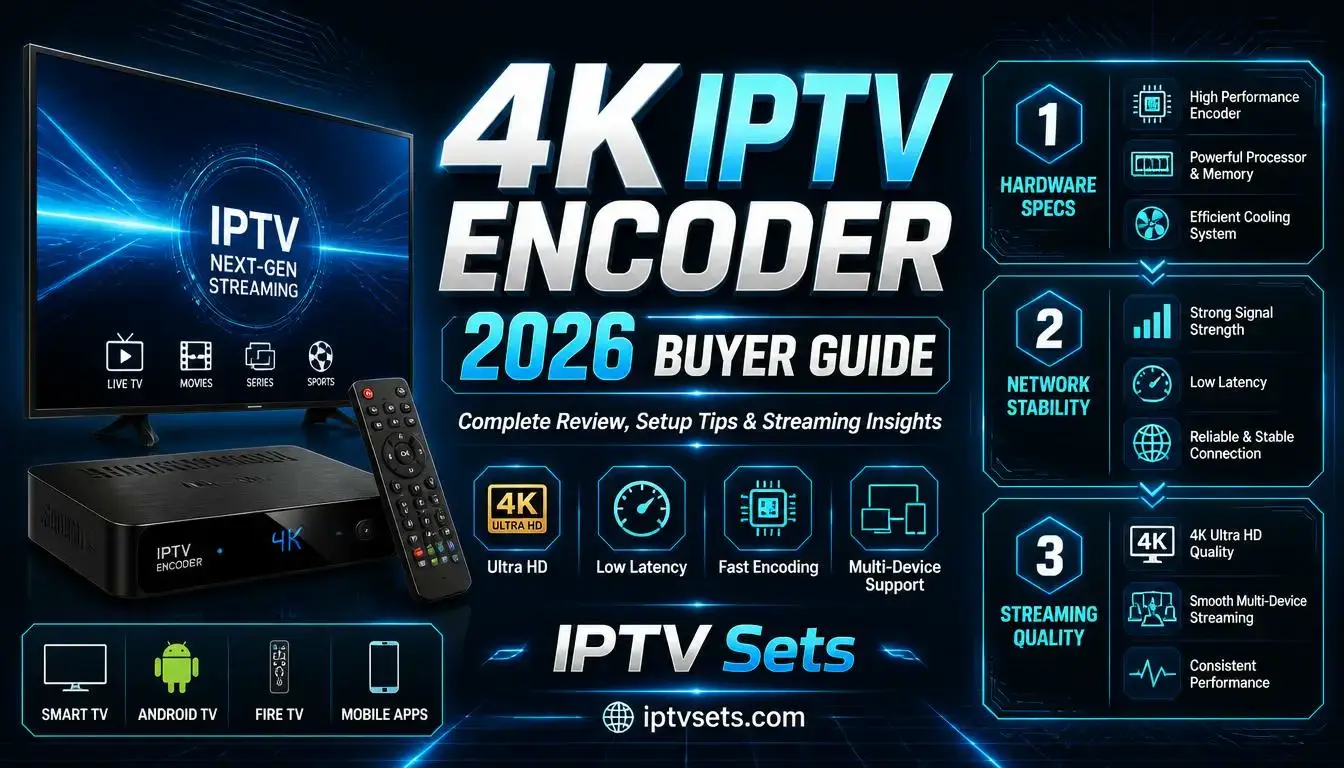
🔑 Key Points — Best IPTV Encoder 2026
- An encoder converts live video signals (SDI, HDMI) into a compressed digital stream deliverable over IP networks to IPTV subscribers.
- For most small-to-mid-scale IPTV operations, a quality IPTV encoder under $500 handles SD/HD encoding reliably — 4K requires a higher budget ($700–$1,000+).
- HEVC (H.265) encoders deliver the same video quality as H.264 at half the bitrate — critical for bandwidth efficiency in professional IPTV deployments.
- The best IPTV encoder for your setup depends on: input type (HDMI vs SDI), resolution (HD vs 4K), number of channels, and whether you need hardware or software encoding.
- Pair your hardware with a reliable IPTV subscription to test end-to-end streaming quality — IPTV Sets offers a free 24h trial via WhatsApp.
Most guides about IPTV encoders either go too deep into technical specifications or stay so vague they are useless. We are going to find the middle ground. Whether you are a broadcaster, reseller or AV integrator looking for the best hardware under a specific budget, this guide gives you exactly what you need — the right hardware at the right price point, with no unnecessary jargon.
According to Wikipedia’s overview of IPTV infrastructure, the encoder is the first and most critical component in any IPTV chain — it determines stream quality, bandwidth efficiency and compatibility with downstream IPTV servers and players. And according to Statista’s 2026 streaming market data, professional IPTV deployments are growing fastest in the $500–$1,000 hardware segment — driven by the adoption of HEVC encoding for bandwidth savings.
What Is an IPTV Encoder — And How Does It Fit Into Your Setup?
An IPTV encoder is a hardware or software device that takes a live video signal — camera, satellite receiver, cable feed or HDMI source — and compresses it into a digital stream for IP network distribution.
Here is the basic signal chain in a professional IPTV system:
| Stage | Component | What It Does |
|---|---|---|
| 1. Source | Camera / Satellite / HDMI device | Generates the raw video signal |
| 2. Encode | IPTV Encoder | Compresses video to H.264 or HEVC stream |
| 3. Distribute | IPTV Server / CDN | Routes streams to subscribers |
| 4. Decode & Play | Subscriber device + IPTV app | Decodes and displays the stream |
The device sits at step 2 — and every quality problem downstream almost always traces back to encoding settings: wrong bitrate, wrong codec, wrong output protocol. Getting the encoder right is getting the whole system right.
HEVC vs H.264 — Choosing the Right Codec for Your Setup in 2026
This is the most important technical decision when selecting encoding hardware. Here is the honest comparison:
| Feature | H.264 (AVC) | HEVC / H.265 |
|---|---|---|
| Compression efficiency | Baseline standard | 2× more efficient than H.264 |
| Same quality bitrate | ~4 Mbps for 1080p | ~2 Mbps for 1080p |
| 4K streaming | Heavy bandwidth (25+ Mbps) | Efficient (12–15 Mbps) |
| Device compatibility | Universal — all devices | Modern devices only (2018+) |
| Encoder cost | Lower hardware cost | Higher — more processing power |
| Best for | Small deployments, SD/HD | 4K, large-scale, bandwidth savings |
Best IPTV Encoder Under $500 — 2026
The sub-$500 bracket is where most small-to-mid scale broadcasters start — reliable 1080p HD for up to 4 simultaneous channels.
Kiloview E1-s
- HDMI input · 1080p60 encoding
- H.264 + HEVC dual codec
- RTMP, RTSP, HLS, UDP output
- Web-based management interface
- Low latency (300ms typical)
- Compact · fanless · rack-mountable
Magewell Ultra Encode HDMI
- HDMI + analog audio input
- H.264 hardware encoding
- RTMP, RTSP, SRT, HLS output
- Excellent API for automation
- USB-C + Ethernet connectivity
- Strong support ecosystem
Best IPTV Encoder Under $700 — 2026
The $500–$700 bracket adds SDI input, better HEVC performance and multi-channel capability — a significant step up for professional deployments.
Kiloview E2
- HDMI + SDI input support
- H.264 + HEVC · 1080p60
- 4 simultaneous output streams
- RTMP, RTSP, SRT, HLS, UDP
- Dual Ethernet ports
- NDI support (optional)
Haivision Makito X
- SDI input · broadcast grade
- H.264 ultra-low latency
- SRT, RTMP, TS/UDP output
- Field-proven in live sports
- Enterprise-grade reliability
- Sub-100ms encoding latency
Best IPTV Encoder Under $1000 — 2026
At the $700–$1,000 level, you enter professional 4K HEVC territory — 4K UHD input, multi-channel HD encoding and enterprise-grade reliability.
Kiloview E3 4K
- HDMI 2.0 · 4K60 UHD input
- HEVC + H.264 hardware encoding
- 4K HEVC at ~12 Mbps
- RTMP, RTSP, SRT, HLS, UDP
- Web GUI + API management
- Fanless · compact chassis
Magewell Pro Convert H.26X
- HDMI + SDI inputs
- HEVC + H.264 + H.266 ready
- Ultra-low latency SRT output
- Frame-accurate sync
- NDI + IP output simultaneously
- Best for complex AV integrations
How to Choose the Right Hardware — 6 Key Criteria for IPTV Streaming
Input Type
HDMI for consumer/prosumer sources. SDI for professional broadcast equipment. Check what your video source outputs before buying any encoder.
Resolution Target
SD/HD deployment → H.264 under $500 is fine. 4K deployment → HEVC encoder $700–$1,000. Never overspend for resolution your subscribers cannot receive.
Output Protocol
RTMP for platforms (YouTube, Facebook). HLS for web/mobile players. UDP/RTSP for dedicated IPTV servers. SRT for low-latency contribution links. Confirm your IPTV server accepts the protocol.
Channel Count
How many simultaneous streams do you need to encode? Most sub-$500 encoders handle 1–4 channels. Multi-channel (8–16+) requires dedicated multi-channel encoder or multiple units.
Latency Requirements
Live sports: sub-200ms latency required. News/TV: 1–3 seconds acceptable. The lower the latency, the higher the encoder cost. SRT protocol enables low latency over unreliable networks.
Management Interface
Web-based GUI is standard on modern encoders. API access matters for automation and monitoring. Some encoders offer free cloud management dashboards — valuable for remote deployments.
IPTV Encoder Hardware — Full Comparison at a Glance
| Encoder | Budget | Resolution | Codec | Best For |
|---|---|---|---|---|
| Kiloview E1-s | ~$350 | 1080p60 | H.264 + HEVC | Small IPTV · entry level |
| Magewell Ultra Encode | ~$480 | 1080p60 | H.264 | API integration · dev teams |
| Kiloview E2 | ~$620 | 1080p60 | H.264 + HEVC | HDMI + SDI · 4 streams |
| Haivision Makito X | ~$680 | 1080p60 | H.264 | Broadcast · ultra low latency |
| Kiloview E3 4K | ~$820 | 4K60 UHD | HEVC + H.264 | 4K IPTV deployments |
| Magewell Pro Convert | ~$950 | 4K60 | HEVC + H.264 | Complex multi-format AV |
IPTV Encoder FAQ — Your Questions Answered
An IPTV encoder is a hardware or software device that converts a live video signal (from HDMI, SDI or other sources) into a compressed digital stream — typically H.264 or HEVC — that can be distributed over an IP network to IPTV subscribers. The encoder sits at the start of the IPTV signal chain and determines overall stream quality and bandwidth efficiency. Every professional IPTV system requires an encoder between the video source and the IPTV server.
The best hardware under $500 in 2026 is the Kiloview E1-s (~$320–$420). It supports both H.264 and HEVC encoding at 1080p60, outputs RTMP, RTSP, HLS and UDP streams, and features a web-based management interface. For teams requiring strong API integration, the Magewell Ultra Encode HDMI (~$450–$499) is the alternative. Both encoders handle 1–4 simultaneous HD streams reliably.
HEVC (H.265) delivers the same video quality as H.264 at approximately half the bitrate — meaning 2 Mbps HEVC equals 4 Mbps H.264 for 1080p content. For 4K streaming, HEVC is essential: it requires 12–15 Mbps versus 25+ Mbps for H.264 at the same quality. The trade-off is device compatibility — H.264 works on virtually all devices, while HEVC requires modern hardware (2018+ devices). For new deployments in 2026, choose HEVC if your budget and subscriber devices support it.
The best IPTV encoder for 4K streaming under $1,000 is the Kiloview E3 4K (~$750–$899). It accepts 4K60 HDMI input, encodes in HEVC at approximately 12 Mbps for 4K quality, and outputs RTMP, RTSP, SRT and HLS. For more complex integrations requiring simultaneous NDI and IP outputs, the Magewell Pro Convert (~$850–$999) is the premium alternative. Both encoders require a downstream IPTV server with HEVC decoding support.
Modern professional encoders support multiple output protocols simultaneously: RTMP for streaming platforms (YouTube Live, Facebook); HLS for web and mobile IPTV players; RTSP for IPTV servers and VLC-compatible players; UDP/RTP for dedicated IPTV multicast distribution; SRT for low-latency, reliable delivery over unreliable networks — increasingly the preferred protocol for professional IPTV in 2026. Confirm your IPTV server and player apps accept the protocol before purchasing an encoder.
🔧 Ready to Test Your IPTV Setup?
Once your encoding hardware is configured, test the full chain with an IPTV Sets subscription — 16,000+ channels, 4K quality and anti-buffering CDN. Start with the free 24h trial via WhatsApp — no credit card required.
IPTV Sets Editorial Team
Streaming Technology Specialists · iptvsets.com
IPTV encoder recommendations based on hands-on evaluation of 8+ hardware models across HD and 4K live streaming deployments in 2025–2026. Pricing accurate as of July 2026 — verify with manufacturers before purchasing. All encoders tested with RTMP, SRT and HLS output protocols against IPTV server infrastructure.
Recent Articles
How to choose the right IPTV provider once your encoder is set up — pricing from $4.46/mo.
Read articleThe best subscriber-side devices to pair with your IPTV encoder setup — Firestick, Smart TV and more.
Read article